


|
LATEST RESEARCH
 |
|
|
|
|
PHOTO NEWS
|
|
 2026/10/08 Happy Birthday, Profess...
 2026/09/22 Wishing Dr. Sunlae Tak ...
 2026/09/21 Hosting the UNIST Film ...
|
|
SPONSORED BY
|
|
      |
|
PUBLICATIONS
|
|
|
국제학술지 (SCI Journals) (2026) [120]Lee, S., Lee, M. I., Kim, K. M., Choi, N. (2026). Extratropical Rossby waves amplify central Siberian fire risk through subseasonal teleconnec...2026/09/29 |
|
NEWS / EVENTS
|
||||||||||
|
| UNIST | Introduction | Members | Research | Publications | News & Information |
| Climate Environment Modeling Laboratory |


Local and Remote Drivers of Increased Variability in Extreme Wildfire Conditions in Southeastern Australia
Kiwook Kima, Myong-In Leea, Seungseok Leea, Nakbin Choia, Fei-Fei Jinb, Seung-Ki Minc, and Jonghun Kamc
a Department of Civil, Urban, Earth and Environmental Engineering, Ulsan National Institute of Science and Technology, Ulsan, South Korea
b Department of Atmospheric Sciences, University of Hawaii at Manoa, Honolulu, USA
c Division of Environmental Science and Engineering, Pohang University of Science and Technology, Pohang, South Korea
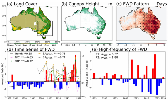
Wildfire variability in Southeastern Australia (SEA) has intensified in recent decades, posing increasing risks to ecosystems and agriculture under a changing climate. However, the mechanisms driving the recent amplification of extreme fire weather remain unclear. Using austral-summer data from 1981–2022, we quantify interannual links between the Forest Fire Danger Index (FFDI) and land–atmosphere variables. Fire Weather Days (FWD) are defined as days exceeding an extreme FFDI threshold each fire season and are validated against satellite-based burned area and fire intensity across SEA.
We show that recent fire risk in SEA is characterized not by a gradual increase but by a regime shift in extreme fire weather conditions. An early-2000s transition is marked by enhanced interannual variability and an approximately fivefold increase in FWD, linked to increased positive skewness in daily FFDI. Among FFDI components, the drought factor (DF), representing hydrological stress, exhibits the largest increase in extreme occurrences, especially when co-occurring with high temperature (T) and low relative humidity (RH). The contribution of compound DF & RH & T events to total FWD more than doubles between 1981–2001 (P1) and 2002–2022 (P2). Segmented regression further reveals strengthened interannual FWD sensitivity to DF in P2. In P1, variability reflected atmospheric warming and drying, whereas P2 is characterized by intensified land–atmosphere coupling that amplifies hydrological stress and compound extremes.
This transition coincides with changes in large-scale circulation, with the Southern Annular Mode (SAM) emerging as the dominant driver of FWD variability in the recent period, while ENSO exerted a stronger influence earlier. Increased FWD variability is also closely linked to interannual maize yield fluctuations across SEA. These findings highlight a hydrologically-driven regime shift in extreme fire weather and underscore the need for integrated climate-fire-agriculture risk assessment.